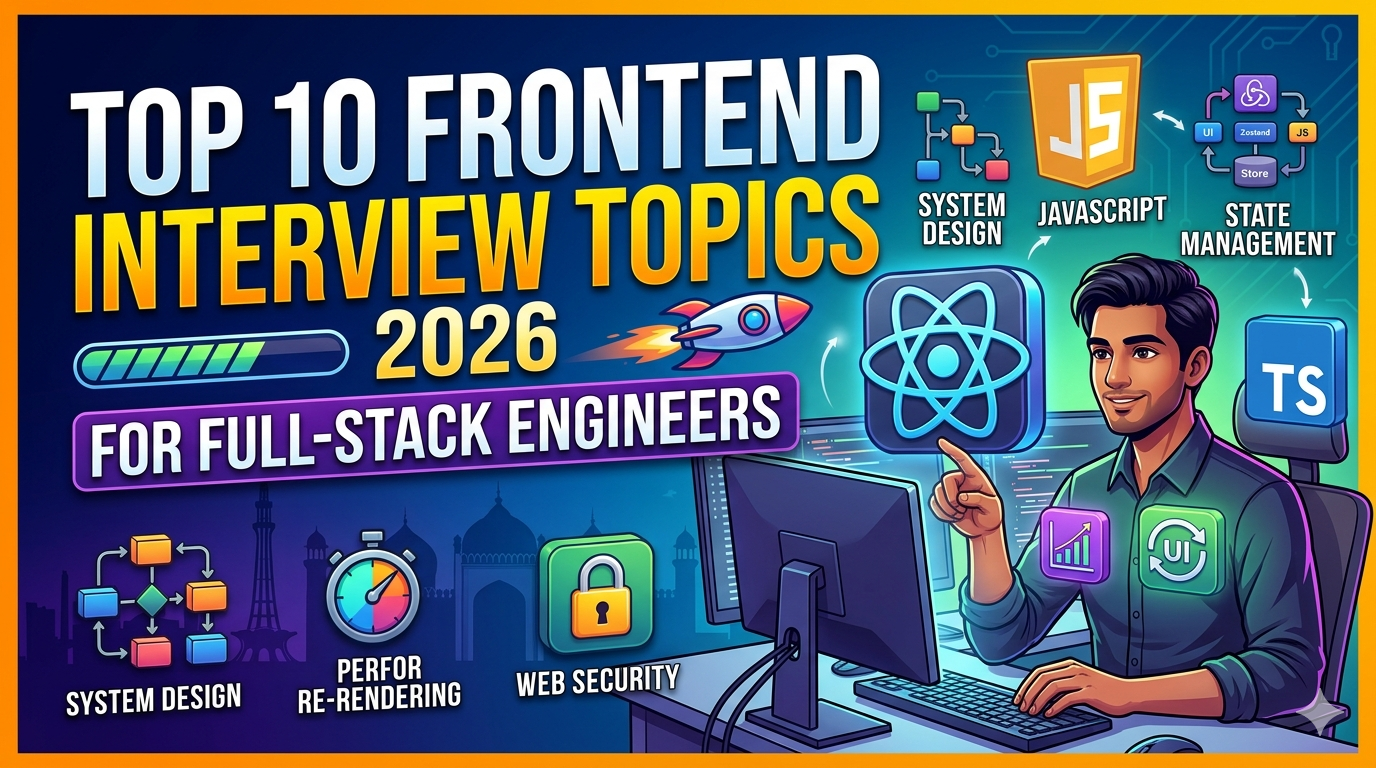
Introduction: The Evolving Landscape of Frontend Engineering in Lahore
Lahore has rapidly transformed into a premier global tech hub, often referred to as the heartbeat of Pakistan's software industry. As the local ecosystem matures, the expectations for Frontend and Full-Stack Engineers have shifted significantly. Gone are the days when "Frontend" simply meant slicing a PSD into HTML and CSS. Today, the top-tier software houses in Lahore—from established giants to high-growth startups—are looking for Product Engineers who can architect scalable, high-performance systems.
In a competitive market where React.js and Next.js have become the industry standard, standing out in a technical interview requires more than just knowing how to build a component. It requires a deep understanding of the "why" behind the "how." Whether you are navigating a rigorous live-coding round or defending your architectural choices in a system design discussion, the goal is to demonstrate a "Senior" mindset: prioritizing performance, maintainability, and user experience.
This article serves as a comprehensive guide for developers in Lahore and beyond. We will dive into the core pillars of modern frontend engineering—ranging from advanced JavaScript internals to the latest paradigms in React 19—to help you navigate the high-stakes technical interviews that define our local industry today.
Section 2: Core JavaScript (Beyond the Basics)
To excel in a modern technical interview, you must move beyond syntax and master the underlying mechanics of the language. In the Lahore tech scene, senior-level interviews often use JavaScript fundamentals to gauge if a developer truly understands the environment their code runs in.
1. The Event Loop & Asynchronous Architecture
JavaScript is single-threaded, yet it handles complex, non-blocking operations with ease. Understanding the Event Loop is non-negotiable. You should be able to explain the interaction between:
- The Call Stack: Where your synchronous code is executed.
- Web APIs / Node APIs: Where long-running tasks (like
fetchorsetTimeout) are handled. - The Microtask Queue: Where Promises and
MutationObservercallbacks wait. - The Macrotask Queue (Task Queue): Where
setTimeoutandsetIntervalcallbacks wait.
Interview Tip: A common "trick" question involves predicting the output of code containing a
setTimeout(..., 0), aPromise.resolve(), and a standardconsole.log. Being able to explain why the Microtask Queue (Promises) takes priority over the Macrotask Queue marks you as a sophisticated engineer.
2. Closures and the "Lexical Environment"
Closures are the functional backbone of modern frontend development, particularly in React Hooks. You shouldn't just define a closure; you should explain its practical utility:
- Data Encapsulation: Using closures to create private variables.
- State Persistence: How closures allow a function to "remember" the environment in which it was created, even after the outer function has finished executing.
- Practical Example: Explaining how
useStatemaintains state across re-renders using these principles.
3. Prototypal Inheritance vs. Classical Inheritance
While the class keyword (ES6) made JavaScript look like Java or C#, it remains a prototype-based language under the hood. A senior candidate should be able to discuss:
- The Prototype Chain: How objects inherit properties from other objects.
- Shadowing: What happens when a property exists on both the instance and its prototype.
- Memory Efficiency: Why defining methods on the prototype is superior to defining them inside a constructor for memory-intensive applications.
4. Memory Management & Garbage Collection
In large-scale enterprise applications, performance is tied directly to memory. Be prepared to discuss Memory Leaks, specifically common culprits like:
- Forgotten timers or intervals (
setInterval). - Accidental global variables.
- Detached DOM nodes.
Explaining the Mark-and-Sweep algorithm shows an interviewer that you are thinking about the long-term stability and scalability of the product.
Why this matters in the Lahore Market
As Lahore becomes a hub for global software outsourcing and product development, local firms are increasingly handling high-traffic applications. Demonstrating that you understand JavaScript at this level proves you can debug complex production issues that "syntax-only" developers might miss.
Section 3: React Deep Dive: Architecture & Optimization
In the Lahore software industry, the bar for React expertise has moved beyond basic component creation. Interviewers at top-tier firms now look for your ability to manage complex state, optimize rendering, and understand the internal reconciliation process.
1. Reconciliation and the Virtual DOM
To prove you are a senior candidate, you must explain how React actually updates the UI.
- The Diffing Algorithm: How React compares the new Virtual DOM with the previous version.
- Keys in Lists: Why using an index as a key is a "red flag" for performance and state consistency.
- React 18/19 Concurrent Mode: Understanding how React can now prioritize urgent updates (like typing in an input) over non-urgent updates (like filtering a long list).
2. Advanced Hooks & Memoization
Efficiency is the hallmark of a great Frontend Engineer. You should be prepared to discuss when—and more importantly, when not—to use memoization.
**useMemovs.useCallback:** Be ready to explain that while these prevent re-calculations and re-renders, they come with a memory overhead cost.- Custom Hooks: The best way to demonstrate "clean code" is by showing how you extract complex business logic into reusable custom hooks, keeping your UI components lean.
**useReffor DOM Access & Persistence:** Understanding how to persist values across renders without triggering a re-render.
3. State Management Strategy
There is no "one size fits all" for state. A senior developer evaluates the tool based on the project’s needs:
- Context API: Best for low-frequency updates like "Theme" or "User Auth."
- Redux Toolkit / Zustand: Necessary for complex, high-frequency global state in enterprise-level dashboards.
- Server State (React Query / SWR): Why you should stop using
useEffectfor data fetching. Explain how these libraries handle caching, re-validation, and loading states automatically.
4. Performance Optimization Techniques
During a system design or technical round, mention these "pro-level" strategies:
- Code Splitting: Using
React.lazyandSuspenseto reduce the initial bundle size—critical for users in regions with varying network speeds. - Windowing/Virtualization: Using libraries like
react-windowto render only the visible portion of massive lists (e.g., a directory of 5,000+ software houses). - Profiling: Using the React DevTools Profiler to identify and fix "wasted" renders.
Why this matters in the Lahore Market
Lahore-based companies are increasingly building products for international clients where Core Web Vitals and User Experience (UX) are top priorities. Showing that you can build a React app that remains "snappy" even under heavy data loads sets you apart from junior developers who might struggle with performance bottlenecks.
Section 4: Next.js & The Modern Web (The 2026 Standard)
In 2026, Next.js has evolved from a simple React framework into a full-stack runtime. For senior roles in Lahore’s competitive market, interviewers expect you to be proficient in the App Router and the shift toward Server-first architecture.
1. The App Router vs. Pages Router
The transition to the /app directory isn't just a file-system change; it's a paradigm shift. You should be able to articulate the benefits of the modern approach:
- Nested Layouts: Creating persistent UI (like sidebars and navbars) that doesn't re-render during navigation.
- Streaming and Suspense: How to use
loading.jsor React<Suspense>to show instant UI "shells" while heavy data is still fetching. - Route Groups & Parallel Routes: Organizing complex dashboards without affecting the URL structure.
2. React Server Components (RSC) vs. Client Components
This is the most critical topic in modern Next.js interviews. You must know where the "Network Boundary" lies.
- Server Components (Default): Great for fetching data, keeping API keys secure, and reducing the JavaScript bundle size (since the code stays on the server).
- Client Components (
'use client'): Necessary for interactivity, browser APIs (likelocalStorage), and React hooks (useState,useEffect). - The "Golden Rule": Keep Client Components at the "leaves" of your component tree to maximize server-side rendering benefits.
3. Data Fetching and Mutations
Next.js 15+ has simplified how we interact with data. Be ready to explain:
- Server Actions: How to handle form submissions and data mutations directly in async functions without creating a separate API route.
- The
fetchAPI: Understanding Next.js's built-in caching, revalidation (ISR), and therevalidateTagorrevalidatePathfunctions. - Caching Levels: Explaining the difference between the Request Memoization, Data Cache, and Full Route Cache.
4. Advanced SEO & Core Web Vitals
Since SEO is a high priority for product-led companies in Pakistan, emphasize your mastery of:
- The Metadata API: Using static and dynamic metadata (
generateMetadata) to ensure perfect Open Graph (OG) tags and titles. - Next/Image & Next/Font: How these components eliminate Layout Shift (CLS) and optimize assets for faster Largest Contentful Paint (LCP).
- Robots & Sitemaps: Generating dynamic
sitemap.xmlandrobots.txtdirectly within the/appdirectory.
Why this matters in the Lahore Market
Lahore's tech industry is increasingly shifting from "Service" to "Product." Companies are building SaaS platforms and e-commerce engines where initial load speed and SEO are direct revenue drivers. Mastering the Next.js App Router proves you can build professional-grade, "production-ready" applications that rank high on Google and perform flawlessly on any device.
Section 5: CSS & Responsive Design at Scale
In a senior-level interview, styling is no longer just about making things "look pretty." It is about maintainability, performance, and accessibility. As the Lahore tech market matures, companies are moving away from messy global CSS toward structured, modern styling paradigms.
1. Modern Styling Paradigms
Be prepared to defend your choice of styling tools. Most top-tier firms in Lahore have moved toward:
- Tailwind CSS: The industry standard for rapid development. You should be able to explain how its "Utility-First" approach leads to smaller bundle sizes and eliminates "dead CSS."
- CSS Modules: Why they are still the best choice for scoping styles to specific components to avoid global namespace pollution.
- Styled Components / Emotion: The trade-offs of CSS-in-JS (runtime overhead vs. developer experience).
2. The Minimalist & Premium Aesthetic
For high-end product roles, design sensibility is a huge plus. Discuss your approach to Minimalist UI:
- White Space (Negative Space): Using space as a tool to improve readability and focus.
- Typography: The importance of choosing the right weights and line heights for a "premium" feel.
- Design Tokens: Mention using a consistent scale for spacing, colors, and shadows (e.g., using a 4px or 8px grid system).
3. Advanced Layouts: Flexbox vs. Grid
You should be a master of both and know when to use which:
- Flexbox: For 1D layouts (navigation bars, aligning items in a row).
- CSS Grid: For 2D layouts (complex dashboard grids, masonry layouts).
- The "Golden Rule": Use Grid for the layout of the page and Flexbox for the alignment of content within those grid areas.
4. Responsive Design & "Mobile-First"
With varying screen sizes—from high-end 4K monitors in corporate offices to budget smartphones—responsiveness is critical.
- Fluid Typography: Using
clamp()orcalc()for text that scales smoothly without excessive media queries. - Container Queries: The modern way to make components responsive based on the size of their parent container rather than the entire viewport.
- Aspect Ratio: Using the
aspect-ratioproperty to prevent Layout Shift (CLS) when images load.
5. Accessibility (a11y) & Performance
A senior engineer builds for everyone. Mention your commitment to:
- Semantic HTML: Using
<header>,<main>,<nav>, and<button>instead of generic<div>tags. - Color Contrast: Ensuring your "minimalist" palette meets WCAG standards for readability.
- Critical CSS: Ensuring the styles needed for the "Above the Fold" content are loaded first to improve performance scores.
Why this matters in the Lahore Market
Lahore-based companies are increasingly competing on a global stage, where the "look and feel" of an application can determine its success in markets like the UAE, Europe, or the US. Demonstrating that you can bridge the gap between high-end design and technical performance makes you an invaluable asset to any product team.
Section 6: Testing & Quality Assurance
In high-growth tech environments, speed is nothing without stability. For senior roles in Lahore, demonstrating a commitment to testing shows that you aren't just writing code for today, but architecting systems that can be maintained by a team for years.
1. The Testing Pyramid
A senior engineer understands the trade-offs between different levels of testing. You should be able to explain the "Testing Pyramid" and why your strategy prioritizes certain layers:
- Unit Tests (Jest / Vitest): Testing individual functions or components in isolation. These are fast and provide immediate feedback.
- Integration Tests: Ensuring that different parts of your system (e.g., a form and its validation logic) work together correctly.
- End-to-End (E2E) Tests (Cypress / Playwright): Simulating real user journeys—from login to checkout—to ensure the entire system is functional from the user's perspective.
2. Testing Library & "User-Centric" Testing
Avoid the trap of testing implementation details. Instead, advocate for testing how the user interacts with the app.
- React Testing Library (RTL): Focus on querying elements by their roles (e.g.,
getByRole('button')) or labels rather than their internal state or class names. - Mocking APIs: Using tools like Mock Service Worker (MSW) to intercept network requests during tests. This ensures your tests don't fail due to an unstable backend during CI/CD.
3. Test-Driven Development (TDD) vs. "Test-After"
While strict TDD isn't always practical, understanding its philosophy is crucial for interviews.
- The Red-Green-Refactor Cycle: Write a failing test, make it pass with minimal code, then refactor for quality.
- Confidence Over Coverage: Explain that 100% code coverage is a "vanity metric." The goal is to cover critical business logic and high-risk user flows.
4. Continuous Integration (CI) and Automation
A senior mindset extends beyond the local development environment. Mention how you integrate testing into the deployment pipeline:
- GitHub Actions: Automatically running your test suite on every Pull Request to prevent regressions.
- Linting & Pre-commit Hooks: Using Husky or ESLint to ensure that only "clean" and tested code is ever pushed to the repository.
5. Debugging Mastery
Testing is about prevention; debugging is about the cure. Mention your proficiency with:
- Chrome DevTools: Advanced usage of the Network tab, Performance profiler, and Memory snapshots.
- React DevTools: Identifying why a component is re-rendering or tracking the state of a specific hook.
- Source Maps: Debugging minified production code effectively.
Why this matters in the Lahore Market
Many software houses in Lahore handle enterprise-level contracts for international clients. In these projects, a single bug in production can result in significant financial loss or a breach of SLA (Service Level Agreement). Showing that you have a "Test-First" mentality proves that you are a reliable professional who takes full ownership of the quality and longevity of your work.
Section 7: Soft Skills & Technical Leadership
For a Senior Software Engineer, technical brilliance is only half the equation. The other half is your ability to communicate, lead, and take ownership. In the high-stakes environment of Lahore’s top tech firms, these "soft" skills are often what decide who gets the lead roles.
1. Technical Communication & Stakeholder Management
It’s not just about writing code; it's about explaining it. A senior engineer acts as a bridge:
- Explaining "Why" to Non-Technical Peers: Can you explain the benefits of a Next.js migration to a Project Manager or a client without using jargon?
- Cross-Functional Collaboration: Mention your experience working with UI/UX designers to ensure technical feasibility and with Backend engineers to define clean API contracts.
2. Code Ownership & Mentorship
Ownership means seeing a feature through from the first line of code to the final deployment and beyond.
- Code Reviews: Don’t just look for bugs; look for architectural improvements and mentorship opportunities. A senior's review should help a junior developer grow.
- System Thinking: Instead of just fixing a bug, a senior engineer asks, "How can we change the system so this type of bug never happens again?"
3. Community Leadership & Open Source
This is where you can truly stand out in the Lahore market. Mentioning your contribution to the local ecosystem demonstrates a proactive mindset.
- Open Source Contributions: Maintaining projects like the "lahore-software-houses" repository shows you are a community builder who cares about the local industry's growth.
- Knowledge Sharing: Whether it's writing technical blogs or speaking at local meetups, sharing knowledge marks you as a thought leader.
Conclusion: The Roadmap to Success
Mastering the frontend technical interview in 2026 is about more than just memorizing a few React hooks or CSS properties. It is a holistic challenge that tests your ability to think as a system architect, a performance specialist, and a team leader.
As the Lahore tech ecosystem continues to evolve, the distinction between a "coder" and an "engineer" becomes clearer. Top-tier firms are seeking professionals who can navigate the complexities of the Next.js App Router, ensure code stability through rigorous testing, and contribute to a culture of mentorship and open-source growth.
Final Takeaways for Your Interview:
- Master the "Why": Never stop at "how" something works. Understand the Event Loop, the Reconciliation process, and the trade-offs of your architectural choices.
- Focus on the User: Whether it's through SEO, Accessibility, or Performance optimization, always build with the end-user in mind.
- Own the Process: Show that you take responsibility for the entire lifecycle of a feature, from design collaboration to post-deployment monitoring.
The journey to a senior role is one of continuous learning. By staying curious, contributing to the local community, and maintaining high standards for code quality, you won't just pass your next interview—you will help set the standard for the next generation of engineers in Pakistan.
About the Author
Syed Muhammad Hussain Naqvi is a Software Engineer based in Lahore, Pakistan, specializing in Frontend and Full-stack development with a focus on React.js, Next.js, and modern web architecture. He is the maintainer of the "lahore-software-houses" open-source repository and a passionate advocate for minimalist, premium design in the local tech community.
Found this guide helpful? Feel free to share it with your peers or reach out to discuss the latest trends in the Lahore tech scene.